SCOLIOSIS PT JAX · JACKSONVILLE & PONTE VEDRA BEACH, FL
What Is the Onero Program?
Why It’s Different from Regular Exercise for Osteoporosis
By Donné Ordile, PT | Scoliosis PT Jax | Jacksonville & Ponte Vedra, FL
Not all exercise programs actually build bone. Here’s what will.
If you’ve been diagnosed with osteoporosis or osteopenia, you’ve probably been told to exercise. Walk more, do some light stretching, maybe try water aerobics. While staying active is always a good thing, here’s what most people are never told: not all exercise builds bone.
In fact, the type of exercise most commonly recommended for osteoporosis, gentle and low-impact, has very limited evidence for improving bone density. That’s not an opinion. That’s what the research shows.
At Scoliosis PT Jax, we offer the Onero program: an evidence-based exercise protocol specifically designed for people with osteopenia and osteoporosis. It’s different from anything you’ll find in a general fitness class, a standard PT clinic, or a community exercise program. And the difference matters enormously for your bone health.
Here’s what Onero is, why it works, and who it’s right for.
What Is Actually Happening in Your Bones
Onero is a high-intensity resistance and impact exercise program developed by Professor Belinda Beck, a world-leading bone health researcher at Griffith University in Australia. It was created directly from the findings of the LIFTMOR trial, one of the most important studies ever conducted on exercise and bone density.
The program is designed specifically for people diagnosed with osteoporosis (a T-score of -2.5 or below on a DEXA scan), osteopenia (a T-score between -1.0 and -2.5), or those at high risk of fracture due to low bone mass.
Onero is not simply a wellness class. It is a supervised, clinician-led program that must be delivered by certified Onero practitioners, which is exactly what we are at Scoliosis PT Jax. Together, the team brings over 60 years of rehabilitation experience, and that clinical depth shapes how each patient’s program is designed and progressed.
What Is the LIFTMOR Trial?
To understand why Onero is different, you need to know about the research behind it.
The LIFTMOR trial (Lifting Intervention For Training Muscle and Osteoporosis Rehabilitation) was a randomized controlled trial published in the Journal of Bone and Mineral Research in 2018. It compared two groups of postmenopausal women with low bone mass. One group did supervised high-intensity resistance and impact training, including heavy deadlifts, overhead presses, back squats, and jumping chin-ups. The other group followed a standard low-intensity home exercise program.
The results were striking. The high-intensity group showed significant improvements in bone mineral density at the lumbar spine and femoral neck, two of the most fracture-prone areas in osteoporosis. They also showed improvements in posture, functional strength, and balance. The low-intensity group showed no meaningful bone density changes.
The conclusion was clear: bones respond to load. Light exercise does not provide enough mechanical stimulus to trigger bone formation. Heavy, supervised loading does.
Onero translates those LIFTMOR findings directly into a safe, supervised clinical program. To put this in perspective: without intervention, postmenopausal women typically lose 1–2% of bone density per year. Since 2015, ongoing data from Onero clinics shows that 86% of patients increased bone mass at the lumbar spine and 69% increased bone mass at the hip after 12 months of the program — a meaningful reversal of that trend.
A Story From Our Clinic
I want to tell you about Janice
Janice came to us at 80 years old. She had been diagnosed with osteoporosis and had never lifted heavy weights in her life. She was nervous, a little skeptical, and not entirely sure her body could handle what we were asking of it.
We started her on the Onero program, building slowly and carefully from the ground up. Technique first, load second. Every session was tracked.
At her next DEXA scan, Janice showed marked improvements in bone density, exactly what the LIFTMOR research predicted. When she saw her results, she told us she wished she had started years earlier. She is one of many patients who have walked through our doors convinced that it was too late. She is proof that it is not.
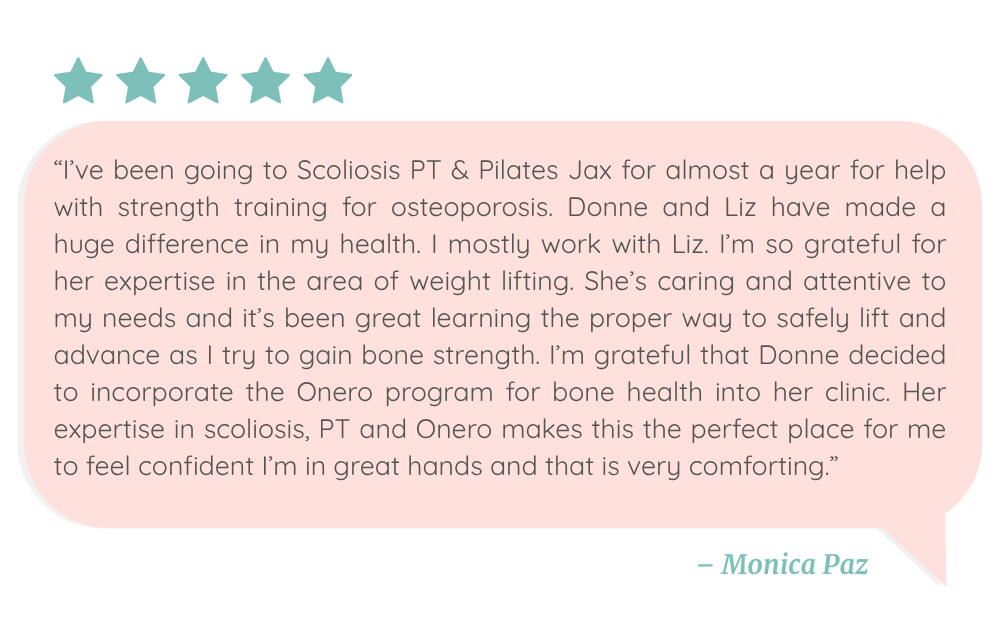
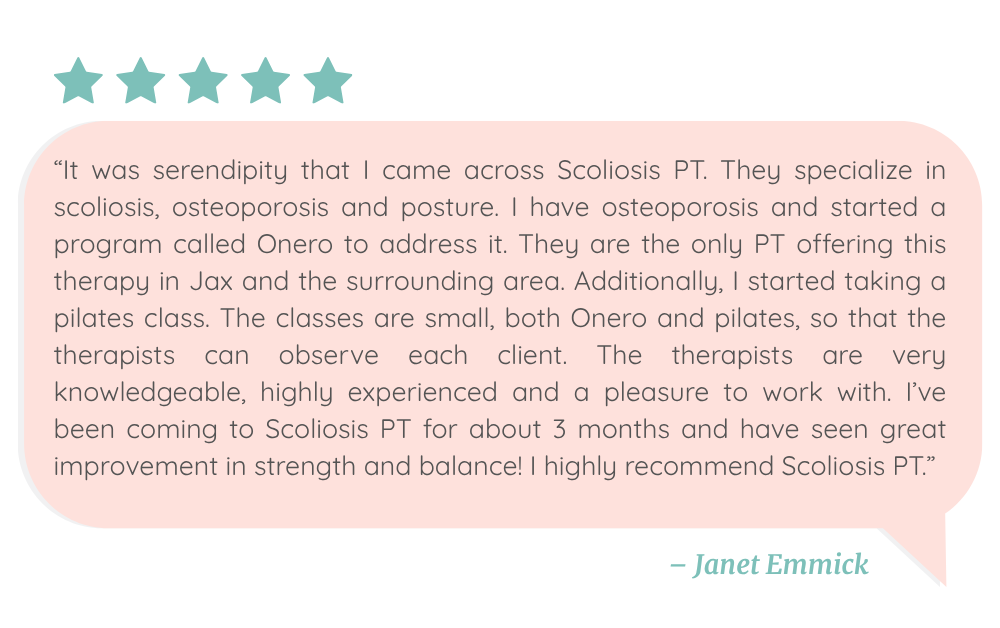
What Our Patients Say
How Is Onero Different from Regular Exercise?
This is the most important thing to understand, and it’s why so many of our patients come to us frustrated after years of being told to “just stay active.”
Walking, swimming, light resistance bands, chair yoga, and low-impact aerobics all have real value for cardiovascular health, balance, and general fitness. But they do not load the skeleton enough to stimulate bone growth. Bones are adaptive. They only become denser when they are challenged with a force that exceeds what they experience in everyday life.
Onero uses four core exercises that are brief, heavy, and weight-bearing — the precise combination the research shows is necessary to build bone:
- Deadlifts
- Overhead Press
- Back squat
- Jumping chin-up with controlled
Every session is supervised by a certified practitioner. Weights are progressed carefully and systematically. Nothing is done by feel. Everything is tracked.
This is not what you’ll find at a gym. It’s not what you’ll find in a generic PT handout. It is a precision program delivered by trained clinicians, based on the best available evidence for bone building.
Is High-Intensity Exercise Safe If I Have Osteoporosis?
This is the question I hear most often, and it’s completely understandable.
The fear is reasonable: if my bones are fragile, won’t lifting heavy weights make things worse?
The LIFTMOR trial directly addressed this question. Participants in the high-intensity group had low bone mass, the same population most clinicians would traditionally steer away from heavy loading. And yet the trial found no serious adverse events in the supervised training group.
The keyword is supervised. Onero is not about picking up the heaviest weight you can find and hoping for the best. Every exercise is taught with precise technique. Weights are increased only when the form is mastered. Your individual health profile, including fracture history, medication, balance, and current strength, is factored into every session.
In my clinical experience, the patients most at risk are not those doing supervised, progressive loading. They are the ones who have been sedentary for years, whose muscles have weakened, whose balance has declined, and who then fall. Onero addresses bone density, muscle strength, balance, and posture all at once.
Think about Janice. At 80, with no lifting background, she not only completed the program safely, she also improved her bone density. The program works precisely because it is supervised and individualized.
Who Is Onero For?
Onero is right for you if:
- You have a diagnosis of osteoporosis or osteopenia from a DEXA scan or REMS
- You want a proactive, evidence-based approach to your bone health
- You are concerned about fracture risk and want to reduce it
- You have been told to exercise, but have never been given a program that actually targets bone
Onero is appropriate for adults of any age, including those with NO prior strength training experience. It is delivered twice a week, and research shows that two supervised sessions per week is enough to stimulate bone formation and improve muscle strength.
What to Expect at Scoliosis PT Jax
When you come to us for Onero, you start with an initial assessment. We review your DEXA scan results, your fracture history, your current activity level, and any other health factors that affect how we design your program.
From there, we build your Onero program from the ground up. You learn each exercise with careful technique coaching before any load is added. We progress you gradually and systematically, always tracking, always adjusting.
Clients often tell us they were nervous before their first session. They leave surprised by how capable they feel. That is intentional. The program is designed to meet you where you are and build from there.
Why This Matters
Osteoporosis is often called a silent disease because most people don’t know they have it until a fracture occurs. Hip fractures in particular can be life-altering and associated with significant loss of independence, long recovery times, and, in older adults, a meaningful increase in mortality risk.
Exercise is one of the most powerful tools available to prevent that outcome. But not all exercise is equal. After 20 years in rehabilitation, I have seen what a difference the right program makes. Onero is the most evidence-based program for bone health.
If you’ve been diagnosed with osteopenia or osteoporosis and you’ve been wondering what to actually do-then join the Onero program and start buildin bone strength.
Frequently Asked Questions
Prior fracture history doesn’t automatically disqualify you, and it’s one of the factors we assess carefully in your initial evaluation. Your fracture history, location, and recovery all inform how we design and progress your program. Many patients with a fracture history participate in Onero safely and successfully.
DEXA scans are typically repeated every 12 months, which is the standard window for measuring bone density changes. Most patients who follow the program consistently see meaningful improvements at that 12-month mark. Strength, balance, and posture improvements are often noticeable within the first few weeks.
The Onero program is not covered by insurance. It is a private-pay program. We encourage you to contact us directly to discuss fees and scheduling so we can find an approach that works for you.
Both are measured using a DEXA scan, which produces a T-score comparing your bone density to that of a healthy young adult. A T-score between -1.0 and -2.5 is classified as osteopenia — lower than normal, but not yet at the threshold for osteoporosis. A T-score of -2.5 or below is classified as osteoporosis. Onero is appropriate for both diagnoses, as well as for people at elevated fracture risk who want to get ahead of further bone loss.
No. Many of our most successful clients, including Janice, who started at age 80, had never lifted weights before. The program is taught from the ground up, with a strong emphasis on technique before any load is added. Your starting point doesn’t matter; your consistency does.
Ready to Take the Next Step?
A hip fracture can change everything, your independence, your mobility, your confidence. The evidence is clear that supervised, progressive loading is one of the most effective tools we have to prevent that outcome. You don’t have to wait for a fracture to act.
We invite you to schedule a free phone consultation with our team. We’ll review your diagnosis, answer your questions about the Onero program, and help you understand whether it’s the right fit for you.
Call us at 904-372-3161 or book your free call online.
You can also visit our Osteoporosis and Onero page to learn more and request an assessment.
Your bones can get stronger. Let’s get started.
References
Beck BR, et al. Exercise and Sports Science Australia (ESSA) position statement on exercise prescription for the prevention and management of osteoporosis. Journal of Science and Medicine in Sport. 2017.
Watson SL, et al. High-Intensity Resistance and Impact Training Improves Bone Mineral Density and Physical Function in Postmenopausal Women With Osteopenia and Osteoporosis: The LIFTMOR Randomized Controlled Trial. Journal of Bone and Mineral Research. 2018.
Beck BR, Weis LJ. Translating high intensity loading for osteoporosis to the real world: Two year observations from The Bone Clinic. Journal of Bone and Mineral Research. 2019.
Scoliosis PT Jax serves patients at two locations:
13000 Sawgrass Village Circle, STE 11, Ponte Vedra, FL 32082 and
8833 Perimeter Park Blvd STE 404, Jacksonville, FL 32216.