Scoliosis Braces Compared: Boston, Rigo, Providence & SpineCOR
When a family walks into our clinic after a scoliosis diagnosis, the discussion about Scoliosis braces comes up fast. Which brace is best? That question deserves a real answer. Not a brochure. Not a one-liner.
I’m Donné Ordile, founder of Scoliosis PT Jax. I’m a Scoliosis Certified Physical Therapist with over 20 years of rehabilitation experience. Our practice serves families in Jacksonville, Ponte Vedra Beach, and throughout Northeast Florida. We focus exclusively on scoliosis.
I’ve sat with hundreds of families. Part of my role, outside of direct PT, is helping families understand their brace options. As a scoliosis specialist, I have a front-row seat to how different braces actually perform. I see how patients move in them. I see how they breathe in them. And I see how expansion chambers, or the lack of them, interact with scoliosis exercises.
- the SpineCOR brace
- the Boston brace
- the Rigo Style brace
- the Providence brace
First: What "Working" Actually Means for a Scoliosis Brace
Before comparing braces, let’s agree on what success means. The Scoliosis Research Society (SRS) defines successful brace treatment as no more than 5 degrees of curve progression through skeletal maturity. The goal is not always to straighten the spine. The goal is to stop it from getting worse and to avoid surgery.
Adolescent idiopathic scoliosis (AIS) is a three-dimensional deformity. It involves a side-to-side curve and a rotation. A brace that only addresses the side-to-side component leaves part of the problem unaddressed. Brace philosophy really matters here. Families in Northeast Florida deserve a clear look at what each option actually does.
The SpineCOR Brace: The One Families Find First on Google
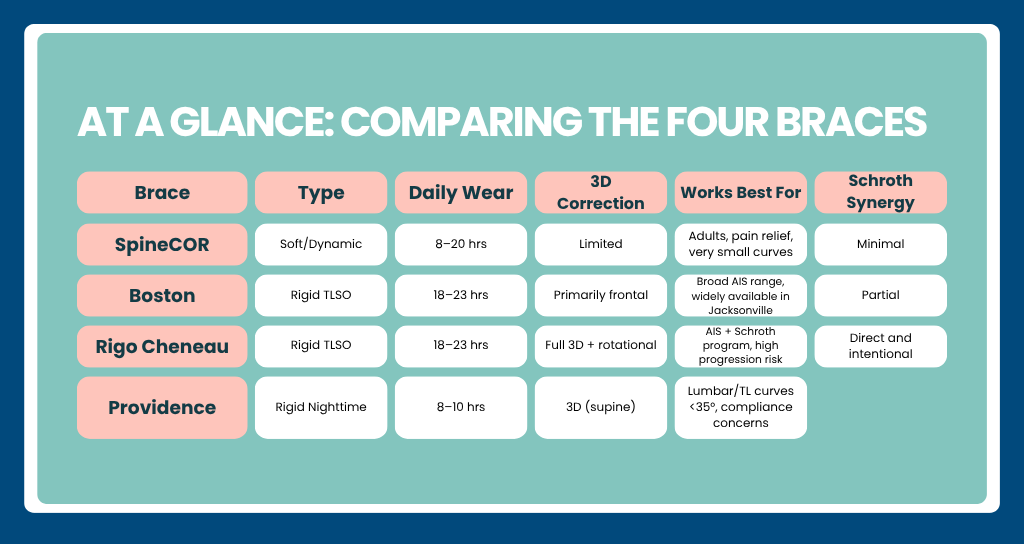
I understand the appeal of SpineCOR. It is soft, flexible, and relatively low-profile. For adults with chronic scoliosis pain, some evidence supports its use for improving comfort and quality of life. But when parents bring it up for their adolescents, I have to be honest about what the research shows.
The research does not support SpineCOR as a primary treatment for adolescents who are still growing and at risk for curve progression.
The most rigorous research trial on this topic is Guo et al., published in the European Spine Journal in 2014. That study found curve progression in 35% of SpineCOR patients. The rigid brace group showed progression in only 5.6% of patients. That is a statistically significant difference.
What I find most telling comes from the same trial. When SpineCOR patients failed and switched to a rigid TLSO, 71% of them regained curve control. That tells you something important about where the corrective force was really coming from.

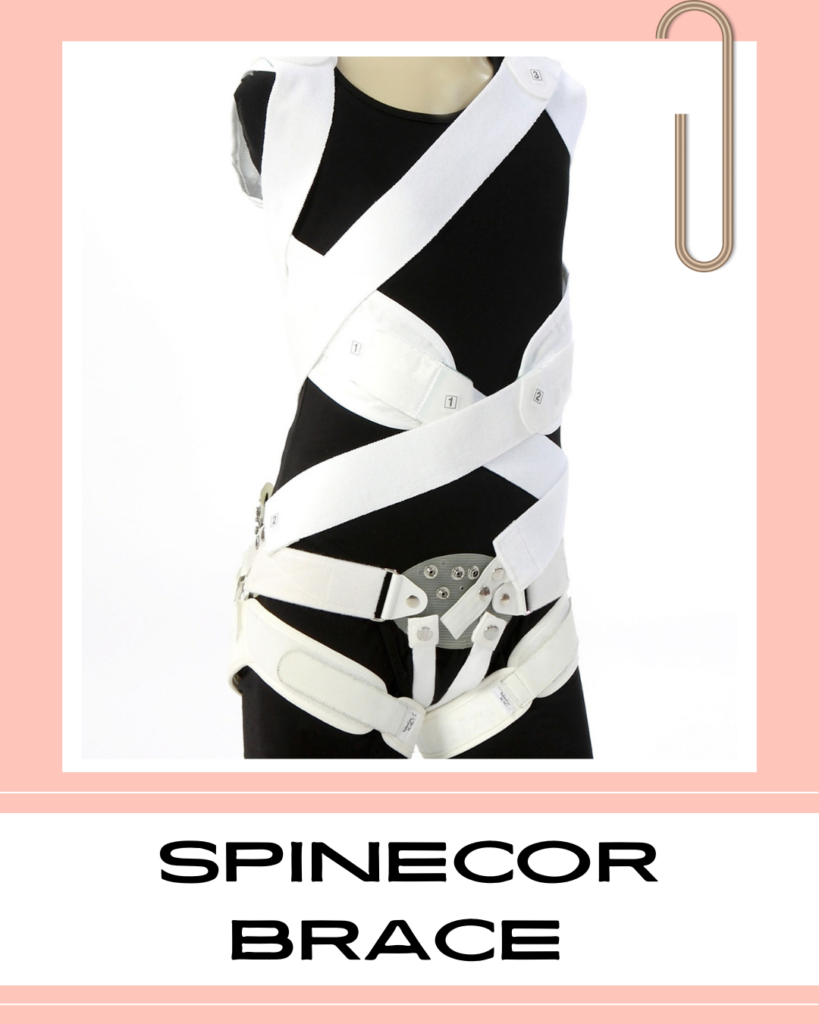
A separate retrospective study (Gutman et al., 2016) reported a 76% progression rate with SpineCOR compared to 55% with the Boston brace.
SpineCOR has a role. For adults, for very small curves, for patients who truly cannot tolerate a rigid device — it’s better than observation alone. But for a growing teenager with a curve in the 20–40 degree range and open growth plates, the evidence consistently favors rigid bracing.
If a provider is recommending a soft brace as the primary treatment for an adolescent who is still growing, I’d encourage you to ask specifically: What does the research say about soft brace outcomes for my child’s curve size and skeletal maturity? How does this compare to rigid bracing in the same population? Those are fair, reasonable questions, and the answers should be part of an informed conversation.
The Providence Scoliosis Brace: The Smart Nighttime Option

The Providence brace occupies a unique and genuinely valuable niche: it’s a rigid, hypercorrective orthosis worn only during sleep typically 8 to 10 hours per night. Because the patient is lying supine, gravity is eliminated, and more aggressive corrective forces can be applied than would be tolerable during waking hours.
For the right patient, this is a legitimately smart tool.
The evidence supports the use of the Providence brace, particularly for lumbar and thoracolumbar curves under 35 degrees.
A 2019 study reported an 89% success rate when in-brace correction exceeded 70%.
One prospective study found a 76% success rate for curves with apices between T8 and L1 — comparable to full-time bracing results in that curve type.
And the compliance advantage is real: a teenager who wears a brace only while sleeping, and can go to school, sports, and social activities in Northeast Florida without it, is going to wear it far more consistently than one miserable in a hard shell for 18 hours a day.
That said, the Providence has meaningful limitations. It is less effective for **high thoracic curves** (apex above T8), where success rates drop to around 61%.
A large retrospective study of 358 patients (2023) found that the Boston brace had a higher overall success rate for moderate curves of 20–40 degrees (59%) than the Providence (46%).
The Providence is an excellent tool when the curve type is appropriate, and compliance is a genuine concern.
The Boston Scoliosis Brace: The Gold Standard Workhorse
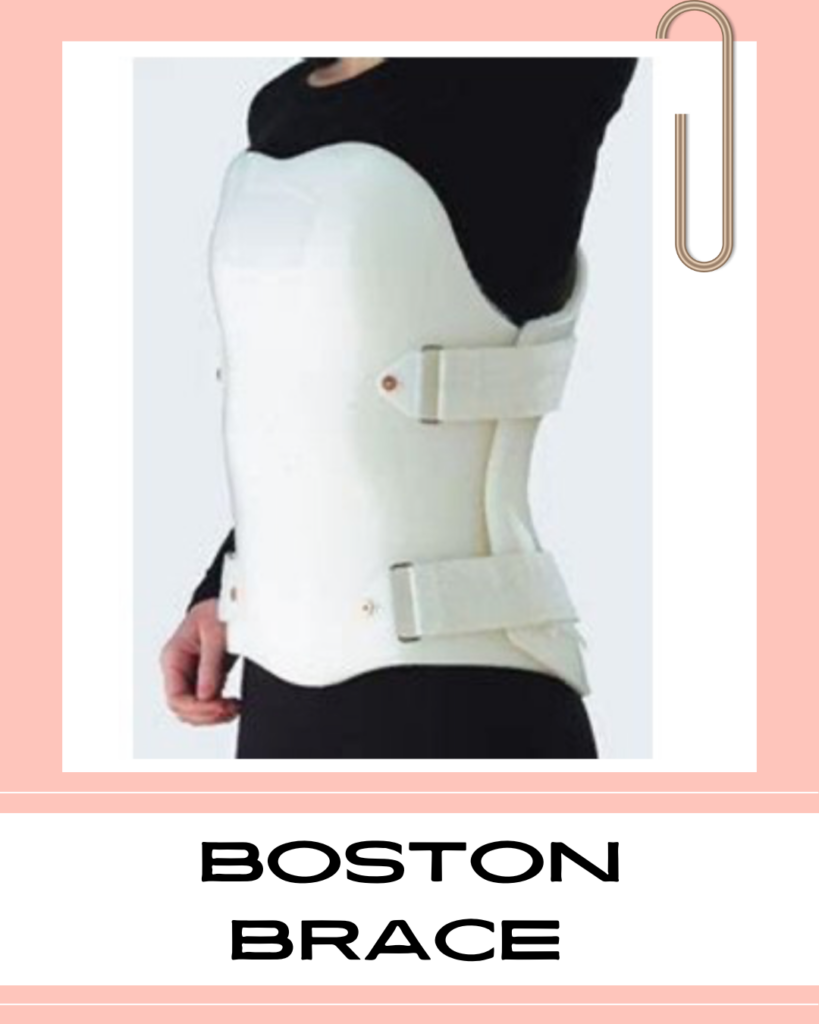
In Jacksonville, the most common rigid brace we see in our clinic is the Boston brace, which is typically fabricated at Nemours Children’s Clinic locally. And that makes sense. The Boston is the most studied scoliosis brace in existence, and it formed the backbone of the landmark BrAIST study (NEJM, 2013) — the multicenter randomized controlled trial that essentially proved bracing works. The trial was stopped early because the evidence in favor of bracing over observation was so strong that they couldn’t ethically continue the control group.
The Boston brace is a custom-molded rigid brace that applies three-point pressure to control curve progression in adolescent idiopathic scoliosis. It has decades of outcomes behind it, tremendous orthotist familiarity here in Jacksonville and across Florida, and a track record that’s hard to argue with. It’s effective, and it’s proven.
But the Boston brace primarily corrects in the frontal plane. It pushes the curve toward the midline. What it does not address as precisely is the rotational component of scoliosis. When you’re practicing the Schroth Method, which is fundamentally a 3D corrective exercise system, you ideally want a brace that speaks the same language. That’s where a Rigo style becomes worth the conversation.
The Rigo Style Brace: Built for 3D Correction and Built for Schroth
If the Boston brace is the workhorse, the Rigo is the precision instrument.
Dr. Jacques Cheneau developed this brace in France in the 1970s after recognizing that scoliosis needed to be addressed in three dimensions, not just side-to-side. Dr. Manuel Rigo later refined the design and classification system. What makes the Rigo Cheneau fundamentally different from a standard brace is its use of **pressure zones and expansion chambers**, open spaces inside the brace where the body is invited to shift into a corrected position. Rather than just pushing the spine from the convex side, the brace creates space on the concave side for the collapsed rib cage to expand.
If you’ve done Schroth therapy with us at our Jacksonville or Ponte Vedra Beach clinic, you’ll recognize exactly what I’m describing. The Schroth Method teaches patients to perform rotational expansion, or opening, of the concave, sunken areas of the ribcage.
In the Rigo brace, the expansion chambers *are* the physical space where those Schroth breathing targets live. They are, quite literally, built for each other. Dr. Cheneau worked alongside Katharina Schroth and her daughter Christa Lehnert-Schroth during the development of his brace.
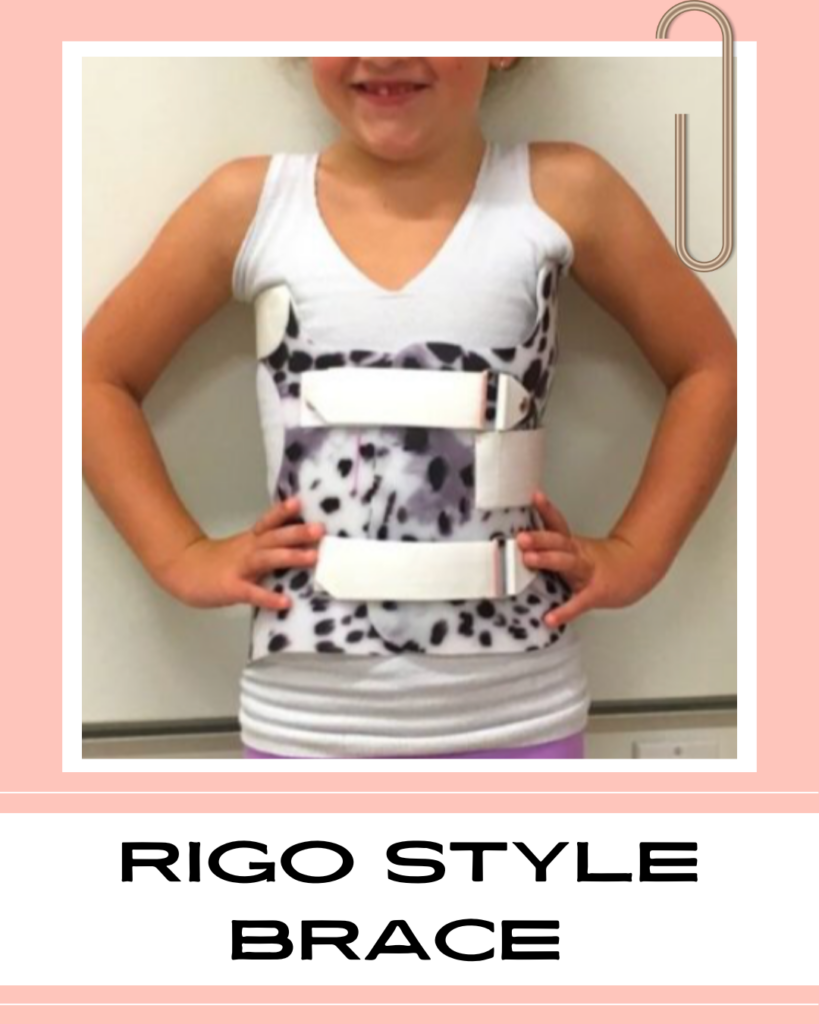
When a client comes to our clinic in Jacksonville wearing a Rigo Type brace, our Schroth exercises don’t just complement the brace, they reinforce it, in the same 3D language, from the inside out. That integration is something special.
Finding a Rigo Orthotist Near Jacksonville, Florida
The orthotist I refer families to in our region is Walter Ramos, based in Gainesville, who founded Scoliosis Today — a practice built around scoliosis bracing specifically. He has the Rigo Cheneau training and hands-on experience that this brace genuinely requires. It does mean a drive from Jacksonville or Ponte Vedra Beach, but for families pursuing a comprehensive treatment plan that pairs bracing with Schroth physical therapy, it’s a trip many of our patients have found worthwhile. I’ve seen solid results in the patients we’ve co-managed with his practice.”
What the Research Shows for the Rigo Cheneau Brace
The outcomes data for the Rigo Cheneau is compelling and growing:
- Minsk et al. (*Scoliosis and Spinal Disorders*, 2017) compared 108 AIS patients treated with either a Rigo Cheneau orthosis or a Boston-style TLSO.
Zero percent of Rigo Cheneau patients progressed to surgery.
Thirty-four percent of TLSO patients did** (p = 0.019). The Rigo group also showed greater mean curve improvement. - A long-term Cheneau brace study using the brace alongside physiotherapy found an average in-brace correction of 72%, with 59% of that correction maintained at five-year follow-up, and no patients required surgery.
- A 2024 study found higher in-brace correction rates and lower rates of curve progression with Rigo Cheneau-style orthoses compared with traditional TLSOs.
- A SOSORT 2014 Award-winning study found that compliant patients using the Rigo Cheneau brace with a specific exercise program saw major Cobb angles improve by an average of 10 degrees. Non-compliant patients progressed by 5.5 degrees, and 3 underwent surgery.
I want to be clear: the Rigo Cheneau brace is not magic, and brace selection should always involve an experienced orthotist and physician. But when families ask me which brace integrates most powerfully with what we do at Scoliosis PT Jax, this is the honest answer.
Brace Questions to Ask Any Scoliosis Provider.
Regardless of which direction your child’s orthotist or physician recommends, here are questions worth asking at any provider — including us. An experienced scoliosis team should welcome all of them:
- Does this brace address all three dimensions of my child’s curve — the lateral component, the rotation, and the sagittal plane?
- What does the published research say about this brace type for my child’s specific curve size and skeletal maturity?
- How does this brace integrate with scoliosis-specific physical therapy, such as the Schroth Method?
- What is the orthotist’s specific training in scoliosis bracing, and how many of these braces do they fabricate per year?
- What is the monitoring plan — how often will X-rays be taken and how will we know if the brace is working?
- If this approach isn’t working, what’s the next step?
How We Support Bracing at Scoliosis PT Jax
We are a scoliosis physical therapy practice, not an orthotics clinic. Brace prescriptions are within the scope of orthotists and physicians, and I have great respect for that scope. But we are active, invested partners in the bracing process at both our Jacksonville and Ponte Vedra Beach locations.
We use the Schroth Method, Pilates, and myofascial release to work with our clients with Scoliosis and poor posture. What I tell every family: a brace only works as well as the compliance and the support system behind it. Kids who understand why the brace matters — and who are doing the right exercises alongside it — do better. That’s what we’re here for.
If you’re navigating a new scoliosis diagnosis in the Jacksonville area, or if your child is already braced and you want to understand how Schroth therapy can amplify the results, we’d love to connect. We offer a free discovery visit — we’ll look at x-rays with you, answer questions, and help you understand what a comprehensive scoliosis treatment program looks like for your specific curve type.
📍 Scoliosis PT Jax Jacksonville & Ponte Vedra Beach, FL scoliosisptjax.com | (904) 372-3161
Frequently Asked Questions: Scoliosis Braces in Jacksonville, FL
What is the best scoliosis brace for a teenager? There is no single “best” brace — it depends on curve type, curve size, skeletal maturity, and whether the patient will be pairing the brace with scoliosis-specific physical therapy like the Schroth Method. That said, research consistently shows rigid braces outperform soft braces for adolescents with active growth potential. For patients pursuing Schroth therapy, the Rigo Cheneau brace offers the most direct 3D integration.
Does the Rigo Cheneau brace work with Schroth therapy? Yes — and this is one of the most compelling things about it. The Rigo Cheneau brace was designed with expansion chambers that correspond directly to the Schroth breathing and corrective movement targets. When a patient practices Schroth exercises while wearing a Rigo Cheneau brace, the two approaches reinforce each other in all three planes of correction. This synergy was intentional from the brace’s original design.
Where can I get a Rigo Cheneau brace near Jacksonville, Florida? Rigo Cheneau braces require specialized orthotist training to fabricate correctly. We refer Jacksonville-area families to Scoliosis Today in Gainesville, Florida — a scoliosis-dedicated orthotics practice with Rigo Cheneau expertise. It’s a drive, but for families committed to comprehensive scoliosis care, it’s worth it.
Is the Providence nighttime brace effective for scoliosis? Yes, for the right curve type. Research supports the Providence brace most strongly for lumbar and thoracolumbar curves under 35 degrees. It is less effective for high thoracic curves. Its biggest advantage is compliance — wearing a brace only during sleep is much easier for teenagers to sustain, and compliance is one of the strongest predictors of bracing success.
Can physical therapy replace a scoliosis brace? Not directly — for curves in the 25–45 degree range during active growth, bracing is the evidence-based standard of care for preventing progression. However, scoliosis-specific physical therapy like the Schroth Method significantly enhances bracing outcomes and is essential for curves that don’t yet meet bracing thresholds. The two work best together.
Does Scoliosis PT Jax offer scoliosis physical therapy in Ponte Vedra Beach? Yes. We have locations in both Jacksonville and Ponte Vedra Beach, Florida, serving families throughout the Northeast Florida region.