Exercise Smart with Scoliosis:
A Friendly Guide to What Helps—and What Hurts
Exercise Smart with Scoliosis: A Friendly Guide to What Helps—and What Hurts
Learn the key movements that support your spine—and the ones to avoid for lasting relief and strength.
3D TWIST OF THE SPINE
Scoliosis is not just the side-to-side curve; it actually curves in 3 dimensions
In addition to bending sideways, the spine also rotates and curves forward or backward, creating a twisted, corkscrew-like effect. This can impact posture, balance, and even lung function in severe cases. The three-dimensional nature of scoliosis explains why treatment often involves bracing or specialized exercises to address not just the visible curve but also the rotational aspects of the condition.
Let's begin with understanding the rotational nature of scoliosis.
Due to this rotation we want to avoid exercises that cause excessive flexion (bending) or twisting of the spine.
Here are a few exercises we generally avoid:
EXERCISE #1 TO AVOID:
Sit-ups and sit-ups with a twist
- Scoliosis is a 3D curvature of the spine, meaning it involves a side curve, but there is also a rotation of the curve forward and backward.
- Sit-ups and sit-ups with a twist encourage spinal flexion (bending forward) and rotation, which can increase the rotational force on the spine.
- These movements may intensify spinal imbalances and contribute to scoliosis progression over time.
Instead, focus on core-stabilizing exercises that promote spinal alignment and strength without excessive bending or twisting.
EXERCISE #2 TO AVOID:
Cat-Cow Stretch
- The Cat-Cow exercise emphasizes repeated flexion (rounding) and extension (arching) of the spine, which can reinforce existing imbalances.
- Excessive spinal movement in these directions may encourage the spine to rotate further in one direction and potentially contribute to progression.
Instead we want to focus on derotational exercises where we bring the spine into the best possible 3-dimensional alignment.
EXERCISE #3 TO AVOID:
Weighted Side Bend for Stronger Obliques
- Scoliosis often involves more than one curve, and these curves go in opposite directions
- Since scoliosis often includes multiple curves, bending to one side may temporarily reduce one curve but can reinforce the imbalance and make the other curve more pronounced.
- Instead, focus on core-stabilizing and elongation-based exercises that support a balanced posture without excessive side bending.
Here are a few essential exercises for a healthy posture if you have scoliosis!
#1 ELONGATION AND LENGTHEN
What You Need To Do First
Since Scoliosis is a 3D curve of the spine we want to begin by lengthening the spine and making space between the vertebra.
COUNTER STRETCH
STEP 1: Stand an arm’s length away from the counter.
STEP 2: Firmly press the palms of your hands into the counter.
STEP 3: Hinge from your hips, bend your knees, and lean down & back.
STEP 4: Do not round your back instead try to imagine balancing a book in the middle of your back..
STEP 5: Reach your sit bones away from your head.
STEP 6: Keep your head in line with your body. Hold 10-15 seconds.
STEP 7: Gently stand up and repeat.
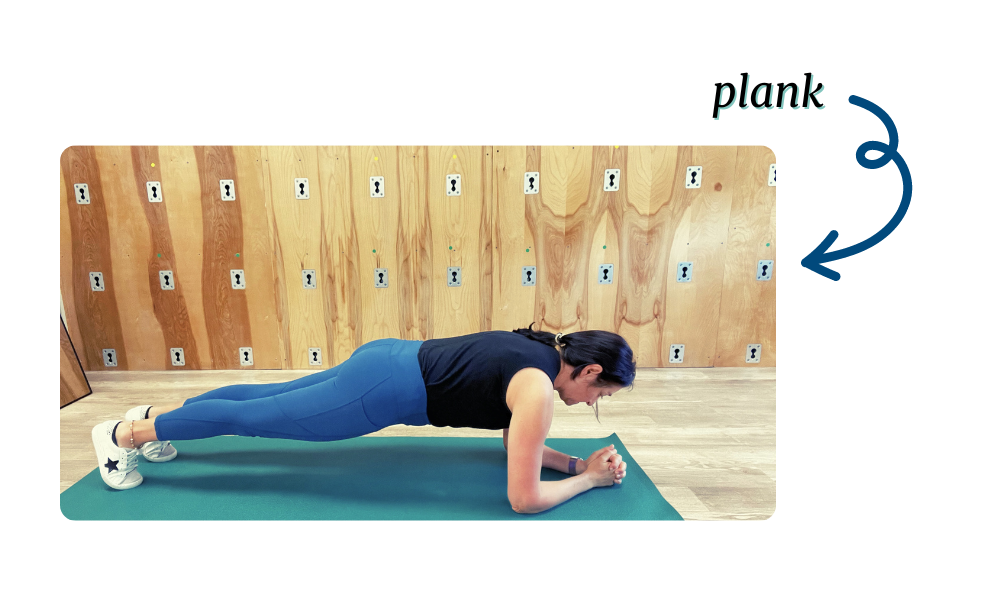
#2 STRENGTHEN THE CORE
Strengthen the Front of the Body
Your core includes more than just your abs. Strengthening in a plank type of position engages more than just the abs.
This exercise can me made easier or advanced. Give it a try and let us know how its goes.

#3 STRENGTHEN THE BACK AND GLUTS
Strengthen the Back of the Body
Your core includes muscles in he back of your body including your gluts, and hamstrings.
Bridging is a great way to strengthen these exercises.
BRIDGING
STEP 1: Relax your head neck and shoulders.
STEP 2: Slowly lift our hips to come up to a bridge position. You want your body to be in one straight line like a ramp.
STEP 3: Maintain equal pressure between your right and left leg and keep your hips level, don’t allow one side to sag lower than the other side.
STEP 4: Slowly come down with your hips
STEP 5: Repeat
STEP 6: Keep head, neck, and shoulders relaxed